
25. Wade Cottage
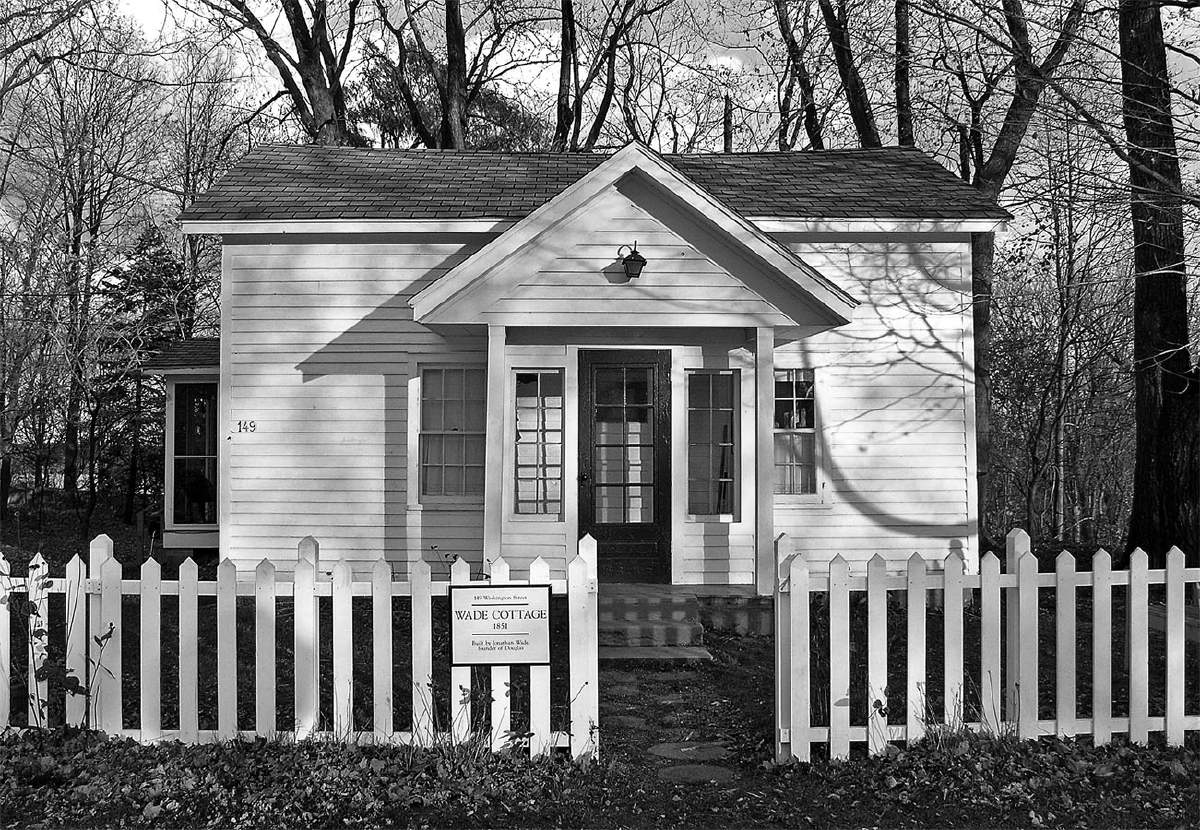
By most accounts, Jonathan Wade and family were the first white settlers in Douglas. Wade settled first in Singapore, where he was part-owner of Singapore’s first lumber mill. He lost his investment when the mill failed and then burned down in 1846. But by 1851 Wade had recovered and was able to purchase a parcel of land [section 16] which eventually became known as Douglas. He built the village’s first lumber mill and its first and oldest house in 1851.
Still standing and little changed except for paint colors and a post-modern addition, Wade Cottage is a traditional two-rooms-up, two-rooms-down house. The main floor was probably a combined living room and kitchen with an attached sleeping room. Two small, low bedrooms are up a narrow stairway. A lean-to kitchen and dining room were added later to the rear. The house is similar in form to the Settler’s House in nearby Holland.
The Wade Cottage is rare surviving example of plank construction. Huge sawn boards placed vertically side-by-side along with heavy beams carry the load of the house. This form of construction was common in the early pioneer era, and may have been copied from local Native American house-building practice. It is probable that the planks were milled by the primitive upright saw at Mr. Wade’s own mill at the opposite end of the street. Clapboard siding and new windows were added later, probably just before the Civil War.