
32. Pottawatomi Marsh and Mack’s Landing
The Pottawatomi Marsh is an ecologically rich wetland and protected wildlife refuge that provides critical habitat for native fish, amphibians, and birds. Seasonal duck hunting and fishing are managed by the private Pottawatomie Gun Club, founded in 1925.
To the southwest, Mack’s Landing is a flat area of riverbank near 62nd Street and Riverside Road. It was the site of an 1820s fur trading post operated by Louis Campau, who later founded Grand Rapids. Mack’s Landing is named after James McCormick, a fisherman and fur trader who kept his canoe at this site in the 1830s.
Sometime before 1873, Mack’s Landing was purchased by Philetus “Phleet” Purdy, who, with his brother Erastus, rebuilt the old trading post as shelter while they worked at logging. When the timber played out, Philetus built a dock along the river and a large home on the bluff overlooking it. In the 1880s, the Purdy family opened a gravel pit near the landing, which proved to be a profitable business, gravel being scarce in the sandy Allegan County soils.
Farm families settled the area, thriving on land cleared by logging. In 1879, 12,000 baskets of fruit were shipped from the landing, in addition to tanbark and cordwood. In 1873, a school house was established that served as the social center for Mack’s Landing, putting on ice cream socials, peach socials, and spelling bees, often challenging neighboring communities.
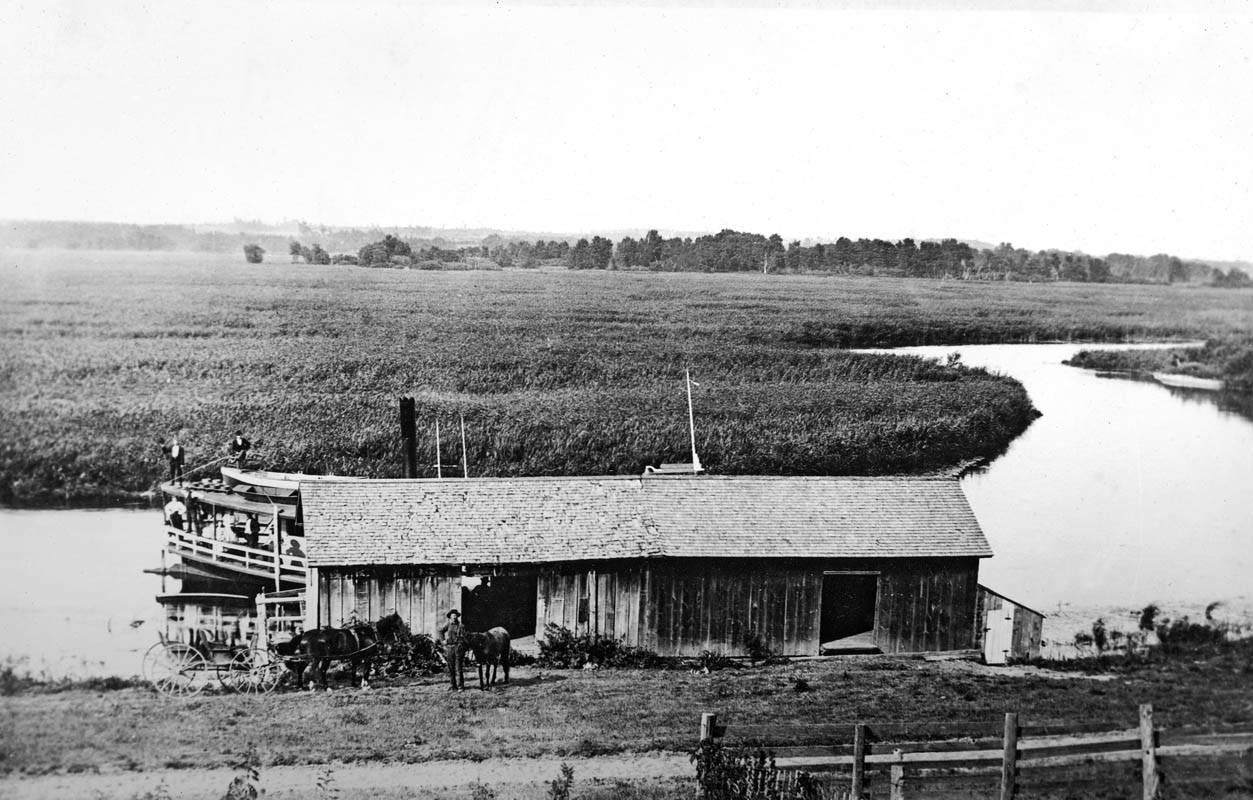
In season, a riverboat traveled daily between what was then known as Purdy Landing and Saugatuck harbor with fruit and farm products. The same boat ran upriver to the railroad station at New Richmond carrying both passengers and freight. From 1881 until she was destroyed by fire in 1887, the 77-foot side paddle wheeler Alice Purdy made the run. She was named for the daughter of Philetus Purdy, who owned a half interest.
[Adapted from Lane, Kit, Lost & Found Ghost Towns of the Saugatuck Area, Saugatuck-Douglas Historical Society, 2000, pages 25-26]