
2. New Harbor
Location: One mile north of the Old Harbor or five miles north of Oval Beach.
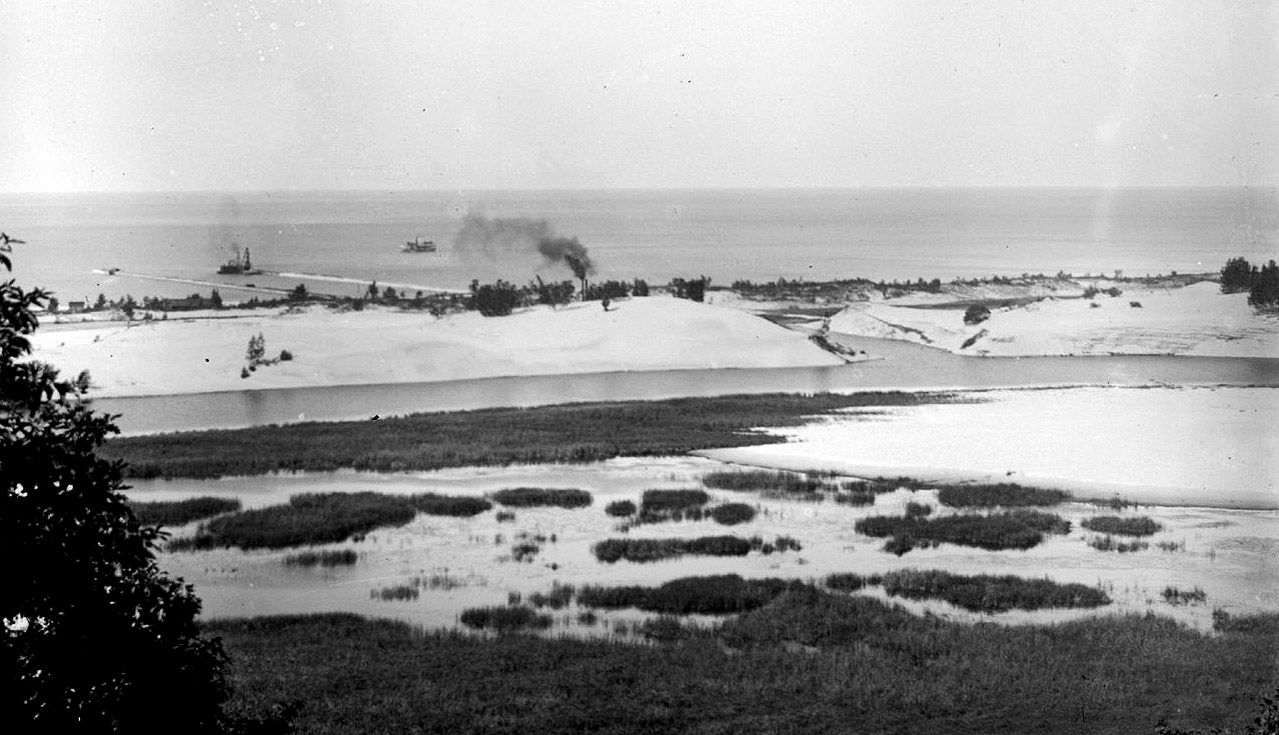
Originally, the Kalamazoo River flowed into Lake Michigan at a spot to the south, closer to Oval Beach. Back then, as the river’s flow neared the lake, it slowed, dropping silt and sand and forming lazy curves that locals called the oxbow — a reference to the U-shaped yokes used to harness oxen. The oxbow was a navigational hazard. Often the water was so shallow Great Lakes ships could not get past sandbars clogging the mouth of the river. Regular dredging and the construction of heavy channel walls and piers proved ineffective. Fishermen, captains of passenger ships, and the farmers who relied on ships to transport their products to urban markets cried out for help.
The solution was to dig a new channel that avoided the oxbow by cutting straight toward the lake at the river’s most northern curve. In 1906, the 1,200-foot long by 200-foot wide by 14-foot deep new channel was completed at a cost of $250,000 (that’s about $9 million today).
Over time, the old river mouth and the oxbow completely silted up, creating hardships and opportunities for the people that lived nearby. The lighthouse was decommissioned. Fishtown, a small community of fishermen and their families, relocated to Saugatuck. Artists from Chicago purchased the struggling Riverside Hotel to become as a summer school of painting. The original route of the Kalamazoo River is now known as the Ox-Bow Lagoon.