
• Visit
    • Plan Your Visit
    • History Center in Douglas
    • Museum at Mt. Baldhead
    • Demerest Fishing Shanty
    • Douglas Walking Tour
    • Additional Sites
  • History
    • History Resources
    • Online Catalog
    • Exhibitions
    • Projects
    • Genealogy
    • Maps
  • Support
    • Support
    • Join
    • Donate
    • Volunteer
    • Sponsor
  • About
    • About SDHC
    • News
    • Staff & Board
  • Events
  • Shop Online
  • Subscribe
  • Contact Us
Skip to Main Content
Search
  • Hours & Locations
  • Shop
  • Donate
  • Visit
    • Plan Your Visit
    • History Center in Douglas
    • Museum at Mt. Baldhead
    • Demerest Fishing Shanty
    • Douglas Walking Tour
    • Additional Sites
  • History
    • History Resources
    • Online Catalog
    • Exhibitions
    • Projects
    • Genealogy
    • Maps
  • Support
    • Support
    • Join
    • Donate
    • Volunteer
    • Sponsor
  • About
    • About SDHC
    • News
    • Staff & Board
  • Events

12. Mt. Baldhead

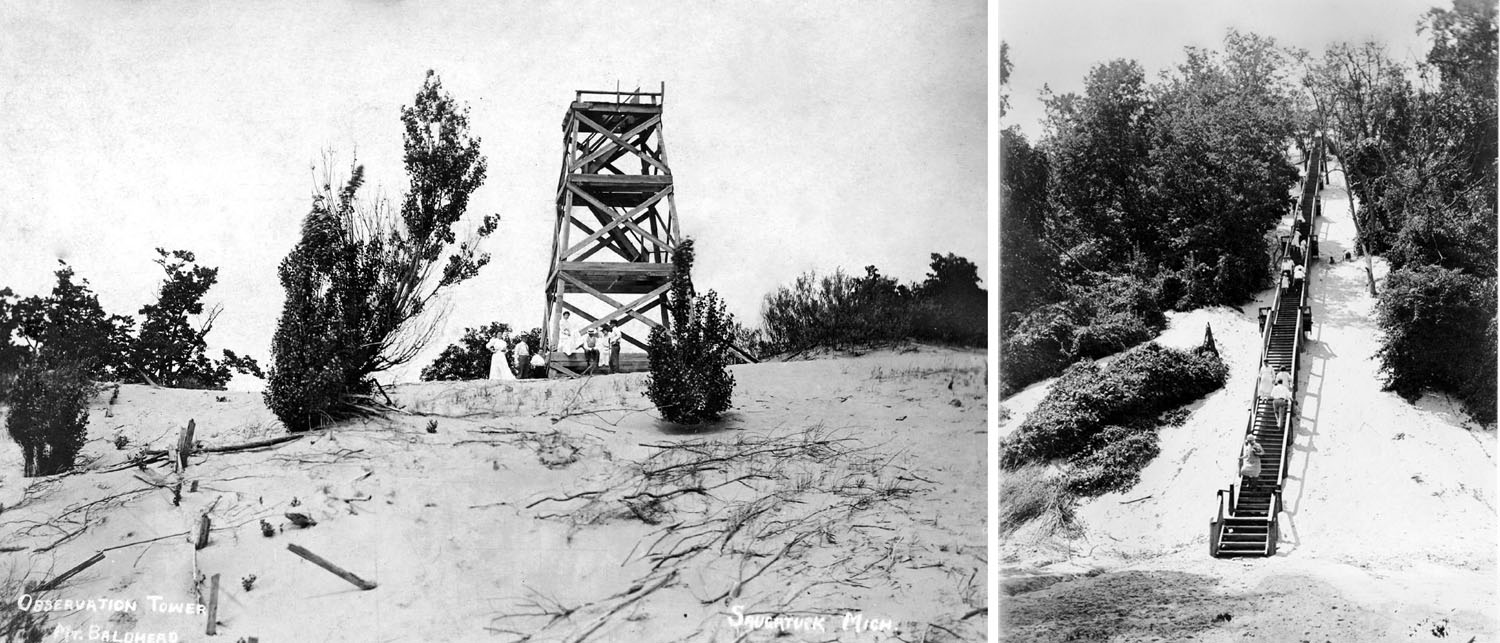
Left: A family posing on the Mt. Baldhead observatory tower, ca. 1900 / Right: Climbing the Mt. Baldhead stairs, ca. 1930

Once home to bald eagles and black bears, this great dune stands between Lake Michigan and the village of Saugatuck. Climbing the soft sand was seen as a worthy quest as early as 1870, when the Fat Men’s Association of Allegan (a social club from an era when extra girth was a sign of prosperity) announced its intention in the newspaper to climb the “bald head” or “die in the attempt.” A wooden observatory tower was built to enhance the terrific views from the top in 1884. Children celebrated the end of the school year with a field trip to the dune that included multiple climbs, swinging on vines and a picnic.

As recently as in the 1920s, the dune was “bald” — lacking vegetation on its golden peak. But when villagers realized the dune was creeping toward the river as a rate of inches per year, which might cause the river to change course and flood Butler Street or cut off access to the lake, trees were planted to stabilize the sand and stairs built to minimize the disturbance from foot traffic.

In 1958, a SAGE gap-filler radar station was constructed atop the dune to scan the sky for incoming Cold War bombing raids. Today, boaters use the decommissioned white, “golf ball” radome as a landmark. In December, an illuminated star marks the holiday season. All year long, climbing the stairs is a scenic, physical challenge.

Contact

P.O. Box 617
Douglas, MI 49406
(269) 857-5751
Contact Us

Hours & Locations

About
  • About
  • Staff & Board
  • Policies
  • News
Subscribe to Our Newsletter

Sign up to receive periodic emails about our activities.

Subscribe

  • Facebook
  • YouTube
  • Instagram
  • Michigan Arts & Culture Council
  • Candid. - Gold Transparency 2023
  • National Endowment for the Arts

© 2026 Saugatuck-Douglas History Center

  • Privacy Policy

Museum Website Design by Landslide Creative