
33. Indian Burial Grounds
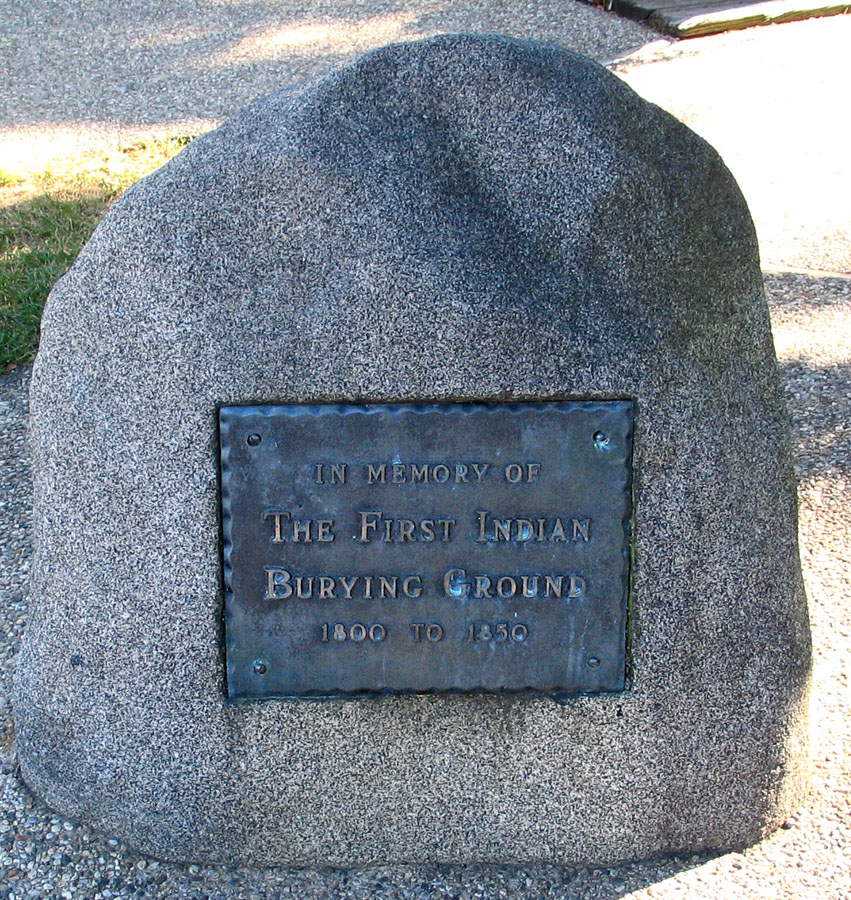
The earliest non-Indigenous settlers found the remnants of a burial ground near the intersection of today’s Culver and Butler streets. They appropriated a portion of that land as a settlement cemetery until about 1860 when the Riverside Cemetery was established north of the village. The graves from the old burial ground were then moved to the new cemetery.
In 1929, when a basement was being dug under the Saugatuck Village Hall, about 30 more Indigenous graves were discovered. Items from the burials were put on display at an informal museum upstairs in the hall and the bones were reburied in a small mound across Culver Street. A memorial boulder and bronze tablet was added in 1930.
During street widening in the 1970s, the mound was bulldozed but the boulder survived. When the Chief Lyle Jones Park was built in 2014, the memorial boulder was moved back across Culver Street, where it remains to this day.
In 2022, Native American Graves Protection and Repatriation Act (NAGPRA) compliance documents filed by the City of Saugatuck revealed that “On an unknown date after 1929, human remains representing, at minimum, three individuals were removed from the Saugatuck site (20AE1) in Allegan County, MI. Workers encountered the burials while constructing the foundation for Saugatuck City Hall. Sometime prior to 1964, the human remains were transferred to the University of Michigan Museum of Anthropological Archaeology (UMMAA) to be reposited. In 1935, George Quimby, an undergraduate student of Archeology studying at UMMAA, recorded in an unpublished report that several post-contact period objects were found in association with the burials. The objects were never transferred to the UMMAA and their current whereabouts are unknown. The human remains are of one child, 2-4 years old, indeterminate sex; one child, approximately 5 years old, indeterminate sex; and one adolescent, under 16 years old, indeterminate sex. No known individuals were identified. No associated funerary objects are present. The human remains have been determined to be Native American based on dental traits, burial treatment, and diagnostic artifacts. A relationship of shared group identity can be reasonably traced between the Native American human remains from this site and the Potawatomi and Ottawa based on multiple lines of evidence. The associated funerary objects noted from the site were typical of the types of goods traded in the region in A.D. 1700-1800.”