
114. Fennville, Hutchins Lake, Vineyards, and Orchards
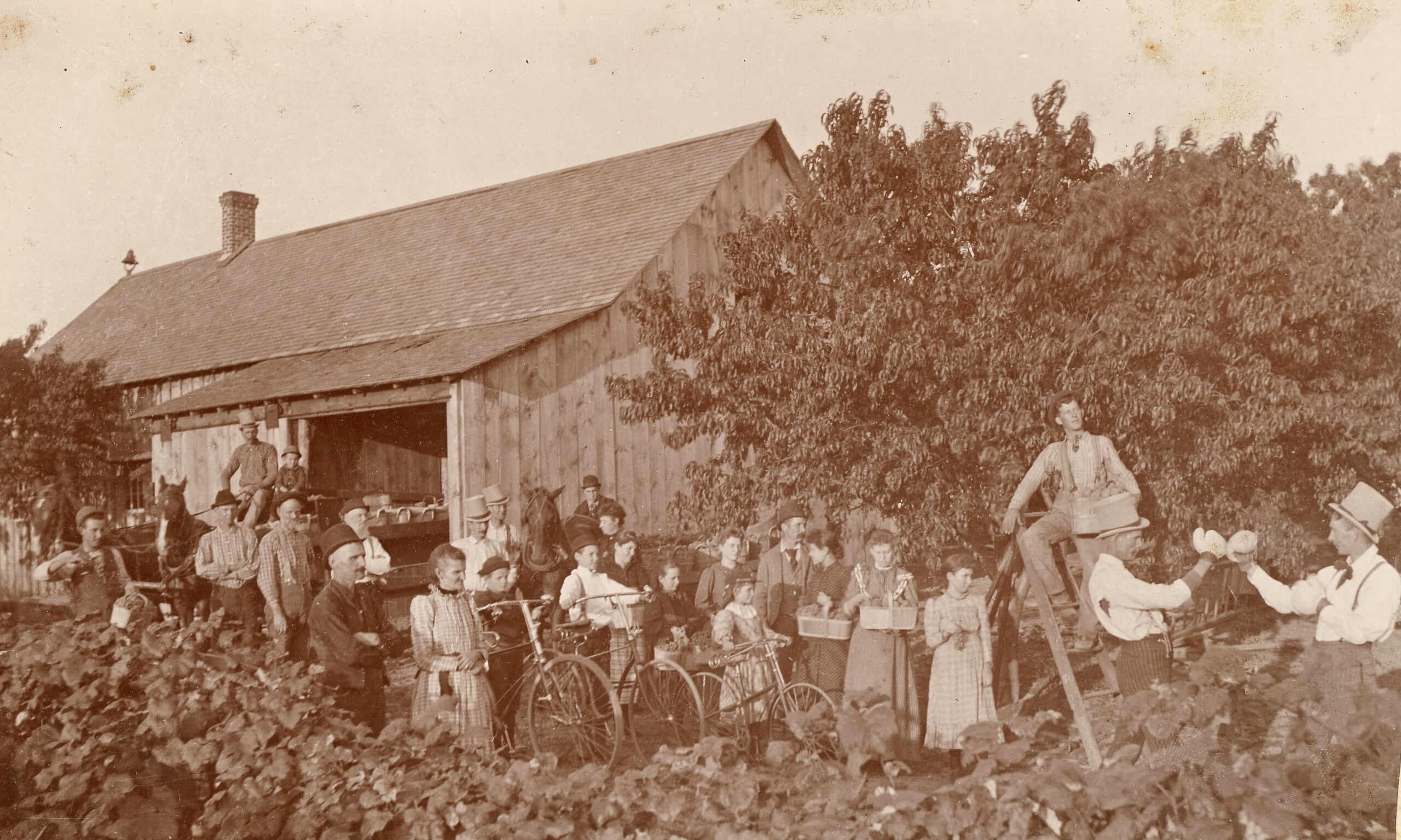
Potawatomi, Ottawa, and Chippewa people originally inhabited the Fennville area. According to legend, the current settlement was established where two “corduroy” log roads crossed a swamp. The first non-indigenous settler was Harrison Hutchins, who built a cabin in 1838 and planted peach trees in 1839. The loamy soil — with an ideal ratio of sand, clay, and humus — and the mild “lake effect” climate made the area ideal for fruit farming.
Fennville was originally called Fenn’s Mills, named for Elam Fenn of New York who arrived in 1851 and erected a sawmill in 1860. The mill town grew slowly until 1870, when it became known that the Michigan Lake Shore Railroad would pass through town. A large hotel was built in expectation. On October 9, 1871, concurrent with the Great Chicago Fire, the town was destroyed by a massive fire. According to Elam Fenn, the townspeople gathered all their worldly possession in the center of a plowed field and fought the fire until 3 a.m., when rain began to fall. The town was rapidly rebuilt. A new sawmill churned out the lumber for reconstruction.
Legend has it that a railroad official suggested changing the town’s name to “Fennville,” claiming it was easier for conductors to call out. The town was listed as Fennville in the first railroad schedule, and soon the post office changed its name to match. In 1889, Fennville was officially made a village. As farmers drained the swamps, the fruit industry expanded — cultivating peaches, apples, pears, plums and cherries — and Fennville became known as the “Fruit Basket of Allegan County.”
Spring-fed Hutchins Lake, named after Fennville settlers David and Harrison Hutchins who owned property to the north, is one of the larger natural lakes in the county. The Hutchins, like other early settlers, valued the lake solely as place to water livestock and harvest ice. But in 1913, Robert Lindahl built the first summer cottage. Today the lake is surrounded by private homes.
Grapes have been grown in the Fennville area since the late 1800s. In 1981, thanks to efforts by William Welsch of Fenn Valley Vineyards, Fennville was officially designated an American Viticultural Area (AVA), the fourth in the nation.
*Photo credit: “Fennville farm life; BL005707.” In the digital collection Bentley Historical Library: Bentley Image Bank. https://quod.lib.umich.edu/b/