
3. Singapore, the Buried Village
Location: North side of the Kalamazoo River, 4000 feet east of the Lake Michigan shore.
Date: 1837-1875
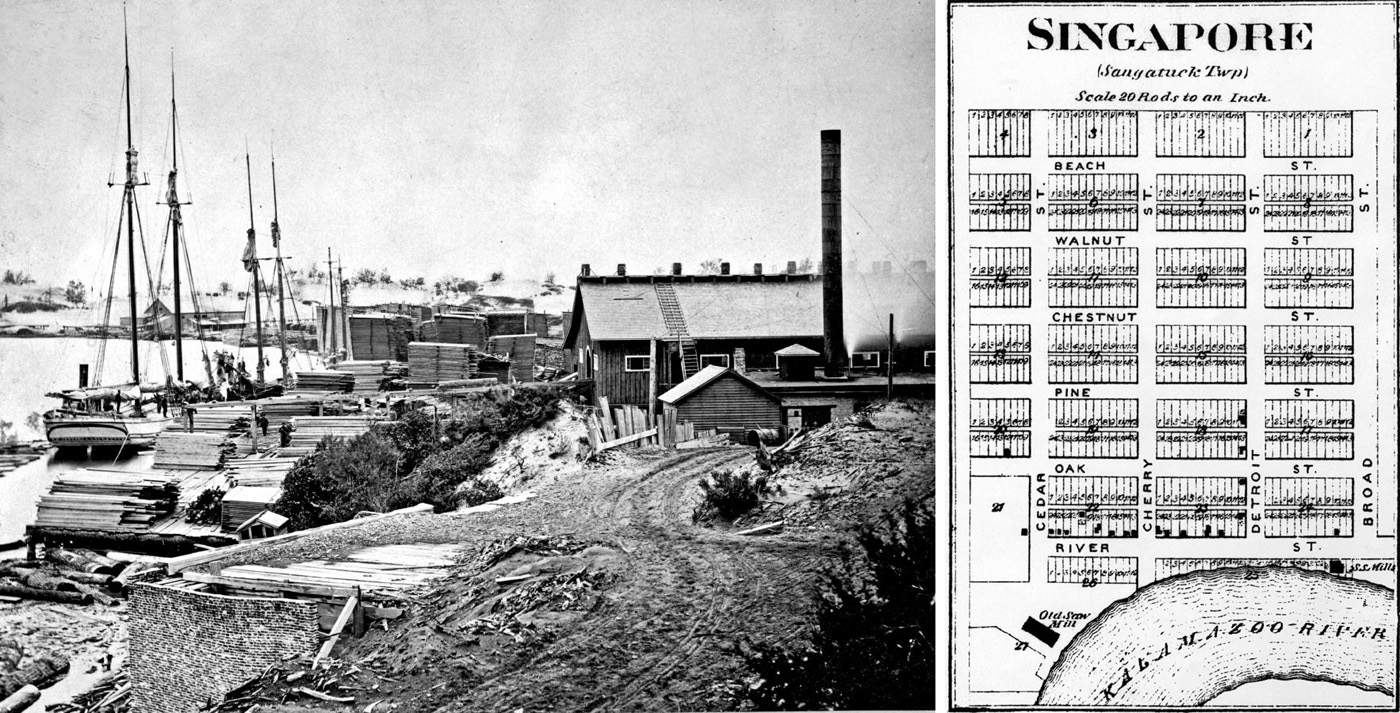
Left: Singapore in 1869 / Right: An optimistic plat map of the town of Singapore
Singapore was a famous lumber-mill town founded by Eastern investors in 1837 on the sand dunes near the mouth of the Kalamazoo River. It is said that its founder, a New York lumberman, named it Singapore after the exotic city visited by the Yankee captains in their clipper ships. As a thriving lumber producing center, it was exporting millions of board feet of lumber, by schooner and steamship, to Chicago and elsewhere during the heyday of the lumber boom era. One of Michigan’s earliest three-masted schooner ships, the Octavia, was built at Singapore, and as a port, it was a stopping off point for hundreds of immigrants and others looking for jobs and new homes. Over time it had at four mills, a large boarding house for workers, nearly two dozen houses, a store, schoolroom (an old circular saw was used as a bell), cemetery, and a notorious ‘wild cat–bank which printed more money than it was able to back up with gold. The bank’s artistically designed notes became worthless and the bank closed. The bank building was moved upriver to Saugatuck where it still exists today on Butler Street. By the 1870s the nearby forests of white pine had been clear-cut, the quick profit times were over and the blowing sands of Lake Michigan began to cover the town. One of the major investors was F. B. Stockbridge who moved on to greener pastures—including the United States Senate and a grand mansion in Kalamazoo. The principal mill was dismantled in 1875 and moved north to St. Ignace, Michigan where there were still pine trees to harvest.