
The End of Singapore, 1840
2026.01.12
See complete text in notes section, below.
1835 Logging and Lumbering1836 Singapore
Winthers, Sally
2026.01
Lorenz, Charles J. 1942-1994
1990
11 in
8-1/2 in
039 Singapore
Wilder, Oshea317 Butler, Saugatuck Gallery, Singapore Bank Book StoreHarris, James 1807-1885Loomis, Levi 1810-1892Martin, JosiahMcDonald, Robert A. 1820-1889Moore, Horace Duncan 1821-1915Singapore Hotel/Boarding HouseDenison, Frank A. 1909-2000North Denison propertyBroward Marine "North" 1979-c1999
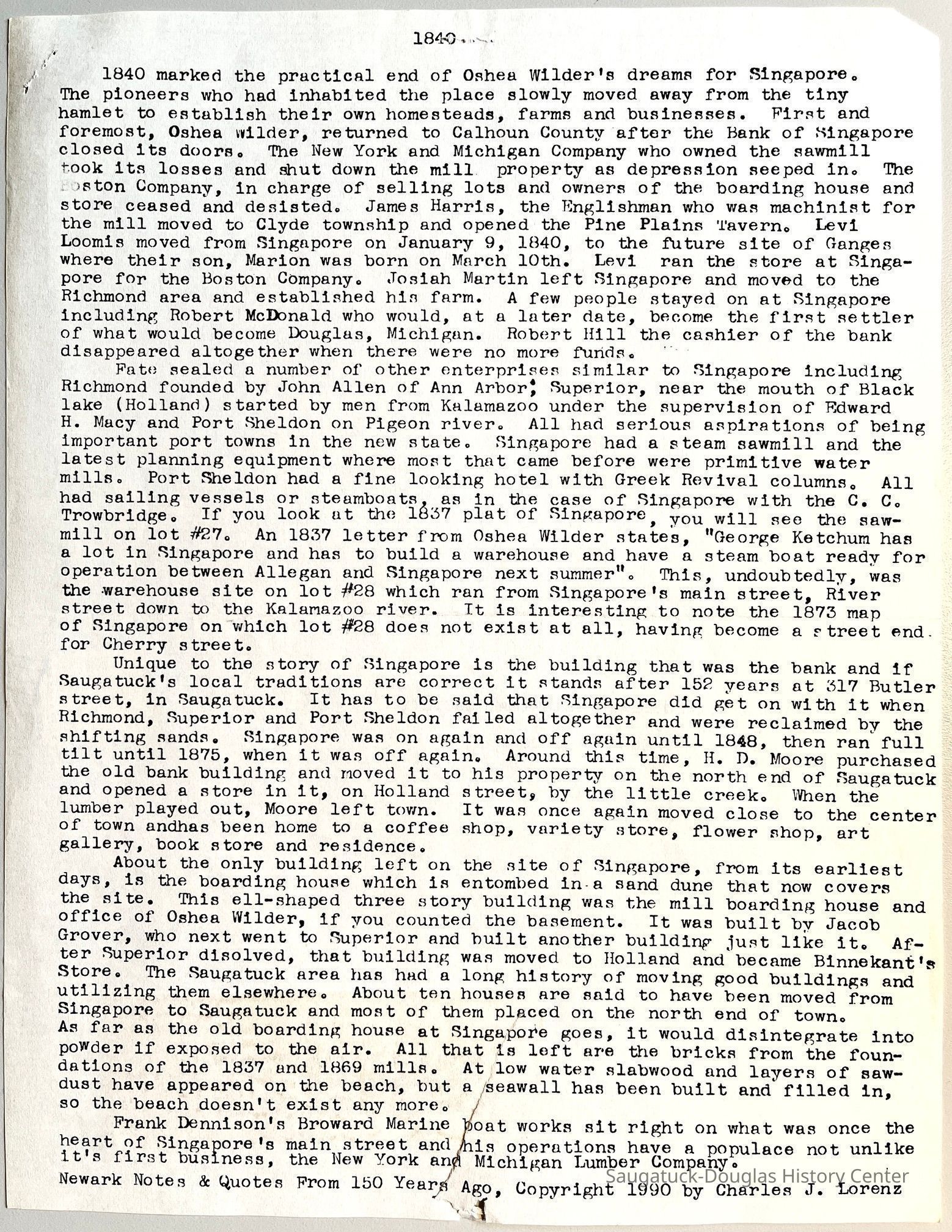
1840 marked the practical end of Oshea Wilder's dreams for Singapore. The pioneers who had inhabited the place slowly moved away from the tiny hamlet to establish their own homesteads, farms and businesses. First and foremost, Oshea Wilder, returned to Calhoun County after the Bank of Singapore closed its doors. The New York and Michigan Company who owned the sawmill took its losses and shut down the mill property as depression seeped in.The Boston Company, in charge of selling lots and owners of the boarding house and store ceased and desisted. James Harris, the Englishman who wan machinist for the mill moved to Clyde township and opened the Pine Plains Tavern. Levi Loomis moved from Singapore on January 9, 1840, to the future site of Ganges where their son, Marion was born on March 10th. Levi ran the store at Singapore for the Boston Company. Josiah Martin left Singapore and moved to the Richmond area and established his farm. A few people stayed on at Singapore including Robert McDonald who would, at a later date, become the first settler of what would become Douglas, Michigan. Robert Hill the cashier of the bank disappeared altogether when there were no more finds. Fate sealed a number of other enterprises similar to Singapore including Richmond founded by John Allen of Ann Arbor; Superior, near the mouth of Black Lake (Holland) started by men from Kalamazoo under the supervision of Edward H. Macy and Port Sheldon on Pigeon River. All had serious aspirations of being important port towns in the new state. Singapore had a steam sawmill and the latest planning equipment where most that came before were primitive water mills. Port Sheldon had a fine looking hotel with Greek Revival columns. All had sailing vessels or steamboats, as in the case of Singapore with the C.C. Trowbridge. If you look at the 1837 plat of Singapore, you will see the sawmill on lot #27 An 1837 letter from Oshea Wilder states, "George Ketchum has a lot in Singapore and has to build a warehouse and have steam boat ready for operation between Allegan and Singapore next summer". This, undoubtedly, was the warehouse site on lot #28 which ran from Singapore's main street, River Street down to the Kalamazoo River. It is interesting to note the 1873 map of Singapore on which lot #28 does not exist at all, having become a street end for Cherry Street. Unique to the story of Singapore is the building that was the bank and if Saugatuck's local traditions are correct it stands after 152 years at 317 Butler Street, in Saugatuck. It has to be said that Singapore did get on with it when Richmond, Superior and Port Sheldon failed altogether and were reclaimed by the shifting sands. Singapore was on again and off again until 1848, then ran full tilt until 1875, when it was off again. Around this time, H. D. Moore purchased the old bank building and moved it to his property on the north end of Saugatuck and opened a store in it, on Holland street, by the little creek. When the lumber played out, Moore left town. It was once again moved close to the center of town and has been home to a coffee shop, variety store, flower shop, art gallery, book store and residence. About the only building left on the site of Singapore, from its earliest days, is the boarding house which is entombed in a sand dune that now covers the site. This ell-shaped three story building was the mill boarding house and office of Oshea Wilder, if you counted the basement. It was built by Jacob Grover, who next went to Superior and built another building just like it. After Superior disolved, that building was moved to Holland and became Binnekant's Store. The Saugatuck area has had a long history of moving good buildings and utilizing them elsewhere. About ten houses are said to have been moved from Singapore to Saugatuck and most of them placed on the north end of town. As far as the old boarding house at Singapore goes, it would disintegrate into powder if exposed to the air. All that is left are the bricks from the foundations of the 1837 and 1869 mills. At low water slabwood and layers of sawdust have appeared on the beach, but a seawall has been built and filled in, so the beach doesn't exist any more. Frank Dennison's Broward Marine boat works sit right on what was once the heart of Singapore's main street and his operations have a populace not unlike it's first business, the New York and Michigan Lumber Company. Newark Notes & Quotes From 150 Years Ago, Copyright 1990 by Charles J. Lorenz
04/15/2026
04/15/2026