
Manlius Township
2026.01.11
See complete text in notes section, below.
1830 Settlement, pioneer eraDevelopment, land1836 Newark/Saugatuck Township government1835 Logging and Lumbering
Winthers, Sally
2026.01
Lorenz, Charles J. 1942-1994
1991
11 in
8-1/2 in
175 Butler & 1830s Settlers
New Richmond/RichmondAllen, John 1796-1851Mann, Ralph, R. 1804-1882Stratton, Jonathan
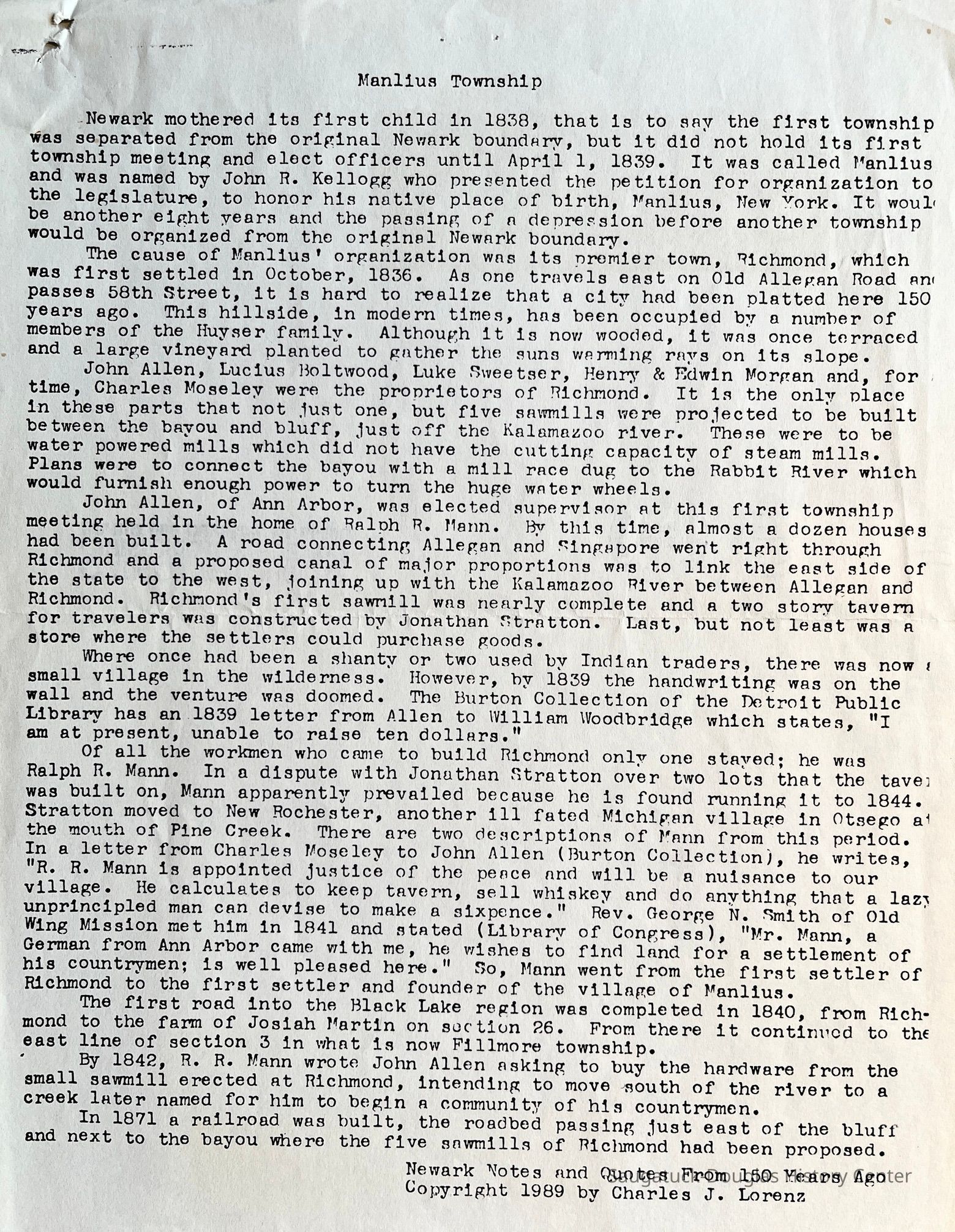
Manlius Township Newark mothered its first child in 1838, that is to say the first township was separated from the original Newark boundary, but it did not hold its first township meeting and elect officers until April 1, 1839. It was called Manlius and was named by John R. Kellogg who presented the petition for organization to the legislature, to honor his native place of birth, Manlius, New York. It would be another eight years and the passing of a depression before another township would be organized from the original Newark boundary. The cause of Manlius' organization was its premier town, Richmond, which was first settled in October, 1836. As one travels east on Old Allepan Road and passes 58th Street, it is hard to realize that a city had been platted here 150 years ago. This hillside, in modern times, has been occupied by a number of members of the Huyser family. Although it is now wooded, it was once terraced and a large vineyard planted to gather the suns warming rays on its slope. John Allen, Lucius Boltwood, Luke Sweetser, Henry & Edwin Morgan and, time, Charles Moseley were the proprietors of Richmond. It is the only place In these parts that not just one, but five sawmills were protected to be built between the bayou and bluff, just off the Kalamazoo River. These were to be water powered mills which did not have the cutting capacity of steam mills. Plans were to connect the bayou with a mill race dug to the Rabbit River which would furnish enough power to turn the huge water wheels. John Allen, of Ann Arbor, was elected supervisor at this first township meeting held in the home of Ralph R. Mann. By this time, almost a dozen houses had been built. A road connecting Allegan and Singapore went right through Richmond and a proposed canal of major proportions was to link the east side of the state to the west, joining up with the Kalamazoo River between Allegan and Richmond. Richmond's first sawmill was nearly complete and a two story tavern for travelers was constructed by Jonathan Stratton. Last, but not least was a store where the settlers could purchase goods. Where once had been a shanty or two used by Indian traders, there was now a small village in the wilderness. However, by 1839 the handwriting was on the wall and the venture was doomed. The Burton Collection of the Detroit Public Library has an 1839 letter from Allen to William Woodbridge which states, "I am at present, unable to raise ten dollars." Of all the workmen who came to build Richmond only one stayed; he was Ralph R. Mann. In a dispute with Jonathan Stratton over two lots that the taven was built on, Mann apparently prevailed because he is found running it to 1844. Stratton moved to New Rochester, another ill fated Michigan village in Otsego at the mouth of Pine Creek. There are two descriptions of Mann from this period. In a letter from Charles Moseley to John Allen (Burton Collection), he writes, "R. R. Mann is appointed justice of the peace and will be a nuisance to our village. He calculates to keep tavern, sell whiskey and do anything that a lazy unprincipled man can devise to make a sixpence." Rev. George N. Smith of Old Wing Mission met him in 1841 and stated (Library of Congress), "Mr. Mann, a German from Ann Arbor came with me, he wishes to find land for a settlement of his countrymen; is well pleased here." So, Mann went from the first settler of Richmond to the first settler and founder of the village of Manlius. The first road into the Black Lake region was completed in 1840, from Richmond to the farm of Josiah Martin on section 26. From there it continued to the east line of section 3 in what is now Fillmore township. By 1842, R. R. Mann wrote John Allen asking to buy the hardware from the small sawmill erected at Richmond, intending to move south of the river to a creek later named for him to begin a community of his countrymen. In 1871 a railroad was built, the roadbed passing just east of the bluff and next to the bayou where the five sawmills of Richmond had been proposed. NEWARK NOTES AND QUOTES FROM 150 YEARS AGO by Charles J. Lorenz, Copyright 1989.
04/15/2026
04/15/2026