
Snapshots - A Saugatuck Album
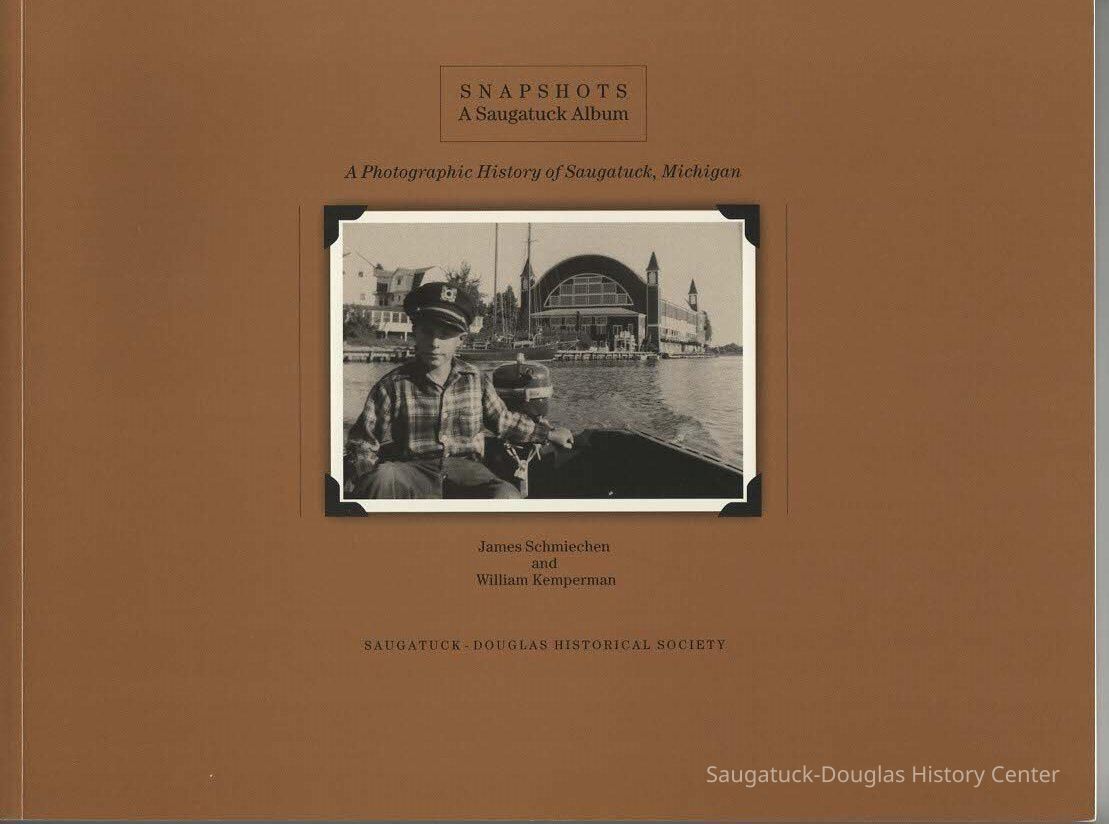
2019.35.103
BooksSDHS Publications
Slusar, Vern
2019.35
SaugatuckDouglasPhotographsMapsshipbuildingBig Pavilionbeachsportsfruit growingSaugatuck (Mich.) -- Pictorial works.Photography -- Michigan -- Saugatuck -- History.Photography.Michigan -- Saugatuck.
Schmiechen, James A.Kemperman, William
SDHS Saugatuck-Douglas Historical Society 1986-2017
Douglas
Michigan
United States of America
North America
2003
977.401 SCH
0965704238
Copy No.: 2
Library
Excellent
Schmiechen, James A.
Kemperman, William
Draft text by James Schmiechen [chapter 8] [title] beach, boats, bathing, and sport [introduction text] Beach, Bathing, Boating, and Sport [238words] It appears that one of the most photographed activities in the Saugatuck area in the first half of the twentieth century was public bathing. Here perhaps is the best example whereby the new snapshot photography of hand-held cameras came face to face with the newest craze of the leisure revolution: going to the beach. Early settlers do not appear to have been interested in the Lake Michigan shore, most likely because they considered the Lake in terms of risk and danger. Nature, in the form of storm and shipwreck, was feared and not worshipped. But with the arrival of the early tourists and cottagers, one of the chief attractions of summers at Lake Michigan was actually getting into the water—and this led to all sorts of rituals surrounding dressing, beach games and frolic, eating at the beach, and, if you did not have a cottage nearby the lake itself, the act of getting to the beach itself. One of the rituals, it is clear, was to photograph the event. In the early resort days, Saugatuck had two Lake Michigan beaches for the public: one, with a privately operated beach house, to the south of the old harbor (approximately where the present Oval Beach is located), and the other not directly on the Lake but at a large cove or “basin” on the backside of a gigantic sand dune where the river made its sharp bend at the site of old Singapore. Access to both beaches was only by boat—usually one of the popular covered boat taxis taken from the docks at Saugatuck, but as time went on, the more affluent folks traveled to the beach in high style by privately owned motorized boats called “skiffs.” Then the Saugatuck village created a new “Oval Beach” when it opened a road to Lake Michigan from Park Street in 1936, and so for the first time, “going to the beach” could be realized by automobile. A third public beach was on the Douglas shore. Here the Douglas village provided for a large and fashionable public beach-house, complete with 19 changing rooms, at the public beach it secured in 1907. Still another beach was available on either side of the gigantic dune that separated Lake Michigan from Goshorn Lake. Then in 1929 the newest concept in American recreation, the outdoor “swimming pool,” came to Saugatuck in a big way when R. W. Marriott of Chicago opened Saugatuck’s “Big Pool” –providing Saugatuck with what was claimed to be the second largest swimming pool in the United States. As these photographs show, the invention of a Michigan beach culture is now well into its second century. [captions] [Ken: first photo below out of order. Full page opposite text] #08-14 [out of order] [ YMCA Group—full page ] a stack of men and boys hamming it up at the beach date unknown [intro text above] MISSING PHOTO B#08-01 [Bathing Beach at Birds Bath House] bird’s bath house, saugatuck beach ca. 1906 Saugatuck’s beach bath house on Lake Michigan was commonly known as Bird’s Bath House. Built in 1897 by A. L. Weed, it had 12 dressing rooms and an office, but as the number of bathers grew the number of changing rooms was increased to 70 and a refreshment stand was added. #08-01A [ Birds Bath House in Winter] [ken: remove written text at bottom of photo] bird’s bath house in winter, saugatuck beach ca. 1906 #08-08 [ Beach Taxi] [Ken: the next two are same subject and could have a single caption: “Beach Taxis”] beach taxis ca.1909 These “launches” were popular steam tugs that provided mass-transit to the beaches in the days before automobile access to Lake Michigan. The Affinity is seen here moored at the chain ferry and near the Big Pavilion where it picked up bathers bound for fun in the sand. With two launches working from this dock, service was each way on the half hour. #08-091r to replace 8.09 [ Launch Gladys] beach taxi gladys ca. 1914 The Launch Gladys loaded with passengers returning from the beach. #08-01B [ New Bathing Beach at Harbor Entrance ] saugatuck’s bathing beach at entrance of new harbor ca. 1911 When the new harbor was dredged open in 1906 it left the old channel to gradually fill with drifting sand, thus closing off the beach and the old bath house. A new place to swim was found alongside this huge sand dune at the basin of the new channel. Today it is all but disappeared, although the basin at the harbor entrance is still a popular place for boaters to moor and swim. Note the terminus of the new pier in view. [ken: below is a big sub-section: Beach Gatherings at the Old Bath House [OUT OF numerical ORDER] #08-04A [ Group on Beach at Bath House –full or ½ page ] fun at the old beach house—a century ago 1900 #08.05A [Best Photo in book. Another Group on Beach at Bath House—full or ½ page] [THE NEXT three ARE PART OF SAME THEME] #08-02, 03,04, 05 [ At the Old Beach House ] #08-06 [ Douglas Beach Bath House ] douglas beach bath house, with swimmers on steps ca. 1912 Built in 1908 by the Village of Douglas as a public bath house, it boasted 19 changing rooms and a large snack bar serving ice cream, sandwiches, soda, and candy. It was operated by Mr. L. A. Phelps. #08-6A [ Goshorn Lake Dune ] beach at goshorn lake high dune ca. 1930 By the 1930s, and largely because more and more people had automobiles, a drive to the beach at nearby Goshorn Lake was popular. Here a giant dune fell off into the water of Goshorn Lake on one side and Lake Michigan on the other. [Ken: here is another sub-section: More Snapshots: lining up and stacking up at beach and dunes #08-10 [ On the Dune at New Harbor Beach ] on the dune at new harbor basin beach ca. 1915 #08-11 [ Deep Sea Diver ] “deep sea diver” ca. 1915 This man’s idea of fun was not being in the water, but under it. #08-12 [ Lady Bather ] ca. 1915 Anna at the beach #8.12A[beach snapshot] #8.12B[beach snapshot] #08-13 [ a stack of 6 Bathers] ca. 1915 no caption #08-15 [ Bathers on Dune – New Harbor ] guys and gals on dune at new harbor – note the cook mansion on hill in background #08-16 [ Lady Bathers ] no caption ca. 1915 #08-17 [three swimmers] three generations swim—the Rastall Men date unknown #08-18 [ Lady on Donkey ] what does one do at the beach in saugatuck? – ride a donkey and have your photo taken by h.c. simonson ! ca. 1909 #08-19 [ The Big Pool Saugatuck] mr. marriott’s big pool in saugatuck ca. 1930 Robert Marriott, a Chicagian and resident of Saugatuck, built this large outdoor swimming pool in 1927. The pool was said to have been the largest in the state, but in 1936, with the opening of the Oval Beach, swimming fanatics left the pool for Lake Michigan—partly because they could now drive to the beach. The Big Pool closed permanently in 1938. Until a few years ago the pool’s bathhouse, seen in background, was used as a residence. It has since been torn down and the big pool was covered over. In the very hot summer months one can still see the outline of the pool in the scorched grass planted over its ‘resting place.’ The Big Pool was located on the north side of North Street at the Saugatuck village boundary. #08-Oval road [ Oval Beach Drive] oval beach drive ca. 1960 First access to the beach by road was made available in 1936. The old beach culture and the new car culture are now merged. #08-20A [add simmons beach photos simmons #004b here] #08-20B [add simmons beach photos simmons #145a here] [‘crowd at beach labor day’] [mother and child at beach, august 1949] both MISSING [new sub-section] out to sea Since the arrival of the leisure culture at the close of the nineteenth-century, Lake Michigan harbor villages have always provided a variety of boating choices. Saugatuck is somewhat unusual in that a good number of the boats to choose from were built in the village. [next photo full page] #2003-8 Boat Livery adams and heath boat livery 1906 The Adams and Heath Boat Livery was located at approximately the foot of Francis Street. Doc Heath ran it from 1900 to 1924 when it was sold to Leonard S. Brittain, a retired ship captain. #08-21 [Regatta Day –Saugatuck ] regatta day at saugatuck 1933 Regatta Day was the precursor to the Venetian Night Festival. It brought yachtsmen form all around the lake and included four days of aquatic sports—with cash prizes. #08 – # 2003 B [out of order]– [Canoeing on the Kalamazoo River] canoeing on the kalamazoo river ca. 1905 #08-07 [out of order][ People in two boats] going to the beach? ca. 1915 Some sun and surf seekers used their own pleasure craft to reach the beach or simply for pleasant cruise. #08-19 [ Row Boat ] The Pah Mah row boat #08-20 [Skiff Mother] Boys on stalled boat, with Big Pavilion in background ca. 1915 #08-21A [ Skiff Mother ] skiff mother, with mrs. maynard and her son bill ca. 1915 [ken: new sub-section] saugatuck and douglas sports #8-22 remove #8-23 remove #08- 24 [ Saugatuck High School Basketball Team ] The Saugatuck High School Basketball Team Ca. 1920 #08- 25 [ Saugatuck High School Basketball Team ] The Saugatuck High School Basketball Team Ca. 1920 #08-26 [ Saugatuck high School Basketball Team] saugatuck high school basketball team Ca. 1925 [insert here] #Unknown 6 [from Book 2003. Chapter 8] saugatuck baseball club 1890 The Saugatuck Baseball Club was organized in 1889. Their park was built about where the current High School is located. #08 –27 [ Saugatuck High School Baseball Team] saugatuck high school baseball team 1926 #08-28 located as ‘Sheridan Album 030? [ Saugatuck High School Band ] saugatuck high school band 1926 #08-29 [Cross Country Team Saugatuck ] cross country team saugatuck 1926 #08-30 [ Lakeshore to Douglas Run – Saugatuck Cross Country Team lakeshore to douglas run, john pear in the lead ca. 1910 #08-30A—see as located in ‘xAddendum 0.30A] [Douglas Baseball team] bill wicks and his douglas baseball teammates no date #08-30B [ DAO ] douglas athletic club, annual dinner The Douglas Athletic Club used the old Methodist Church building (now the Library) on Center Street as their gymnasium. This dinner was held at home of Ky Waltz, seated at left front of table, on Center Street. 1939 #08-31 [ Barber Pole ] …..and then there was the other sport. Ca. 1915
Draft text by James Schmiechen [title for this section] imaging the mill town [chapter introduction text: Early Saugatuck was an marvelously busy and perhaps even “pretty” industrial village of the sort that could be found all over America at the time of the Civil War. It was, in a real sense, very much a part of Chicago’s economic hinterland, for without the amazing post-Civil War growth of Chicago as the greatest lumber market in the world, there would not have been a Saugatuck as we know it today. Beginning in the 1840s, the once quiet woods and harbors of both Saugatuck and Douglas turned into a stampede of noisy factories: flour mills, leather tanneries, shipbuilding yards, and most of all, lumber and shingle mills. It was said that the west half of the county had 29 sawmills during lumber era--much of it then shipped off of Saugatuck and Douglas docks. The Griffin and Henry dock appears as a backdrop to the photo of that mill’s workers in 1880. The material basis for much of this activity, of course, was a great slaughter of the natural resources of the forest. Giant white pines were the source of millions of board feet of lumber and millions of wood shingles; hemlocks the source for the bark that the local tanneries needed to remake hides into leather for everything from horse saddles to shoes. On one day in June of 1870 there were counted nineteen vessels loading at the Saugatuck docks—the year that only the port of Grand Haven surpassed Saugatuck in exports from Lake Michigan’s eastern shore. It is unknown how many men worked as sailors, or as loggers in the woods, or in the lumber mills, but over the years the labor force numbered in the thousands and the early boarding houses of Saugatuck and Douglas were filled. Logging was a winter activity because the most efficient way of moving the cut tree was by a horse or oxen pulled sled along the ice-covered ground out of the forest to a nearby river. Stacking the logs at the water’s edge and then floating the logs to the down-river mills was dangerous work—and loggers were frequently injured. Ironically, William Butler, the founder of Saugatuck—who came to conquer the forest--was killed in a logging accident. For the loggers, as well as sailors and the mill hands, the major forms of escape from their work environment was a night in one of Saugatuck’s many taverns, such as the infamous Lake House Tavern—one of which was targeted for closure by the local temperance advocate, Mrs. Moore and her friend, Susan B. Anthony. The Great Chicago Fire of 1871 speeded up the clear-cutting of the Michigan woods and by the 1880s lumber boom was mostly over and the hemlock trees were stripped, although a number of mills continued to provide lumber for local construction. Fortunes had been made but many of the local investors fled with their cash to opportunities elsewhere. The mills themselves were noisy and dangerous workplaces. Steam boilers often exploded and the whirling saws often cut off hands and fingers. The O. R. Johnson mill (later known as the Spencer, and then the Griffin and Henry mill) was the last of the Saugatuck mills. Few photographs of this early industrial history survive, and several that are typical of this genre are what follows on these pages. Most of them leave a rather grim image of the village, but whatever the case, the photographic images from Saugatuck’s lumber era provide only limited documentation of this story of the industrial ers. What information can be gleaned from these photographs? It is of interest to see that someone thought it important to photograph the mill workers. Who are these people? Who took these photographs? Was the purpose to provide identity to the workers or to the mill owners? The best of the images is that of the great mill at Singapore which not only shows the mill but the fine freight schooner ship, The O. R. Johnson. Johnson was one of the Singapore speculators, moving on west to greener pastures (the future Johnson Wax Company in Wisconsin) when Singapore’s future was in doubt. A study of panorama views of the Saugatuck and Douglas harbors (see the above section “The Setting,”) allows us to see the big picture—visualizing the riverfront as an industrial landscape. Photo #1 [[Caption]] johnson & stockbridge sawmill at old singapore 1869 Looking west, this is one of three mills operating at various times in the lumber mill town site of Singapore, which was at the mouth of Saugatuck’s harbor and had its beginning in 1837. This was the largest of the Singapore mills. It was dismantled and its machinery removed to St. Ignace Michigan in 1875, ending Singapore’s 40-year lumbering saga. The schooner was built in Saugatuck to carry the milled lumber to Chicago and elsewhere. Note the fire buckets on top the mill house. Several mill workers are seen in the doorway to the right. Photo #2 [Caption] clipson’s mill and brewery, showing the first bridge The first bridge connecting Saugatuck and Douglas was built by Ralph Densmore in 1869. Photo -#3, #4 [Caption] saugatuck’s first lumber mill 1846, photo in 1897 Many sawmills have stood on this site on Lake street, Saugatuck. The first mill was constructed in 1846 by Michael B. Spencer. By 1897, the mill was under the proprietorship of Messrs. Griffin & Henry. Photo #5- [Caption] griffin and henry mill crew ca. 1880 Photo - #6 [Caption] old house in the dunes ca. 1910 Early mill worker or fisherman’s house, near Singapore. Photo #7 [Caption] “a handsome load ” Feb 17 1889 These oak logs from the nearby forest were probably bound for Saugatuck’s shipbuilding yards. Photo#8 [Caption] fagan ash with horse team and giant log Ash was a logging operator for the Douglas Basket Factory
08/13/2020
08/11/2026