
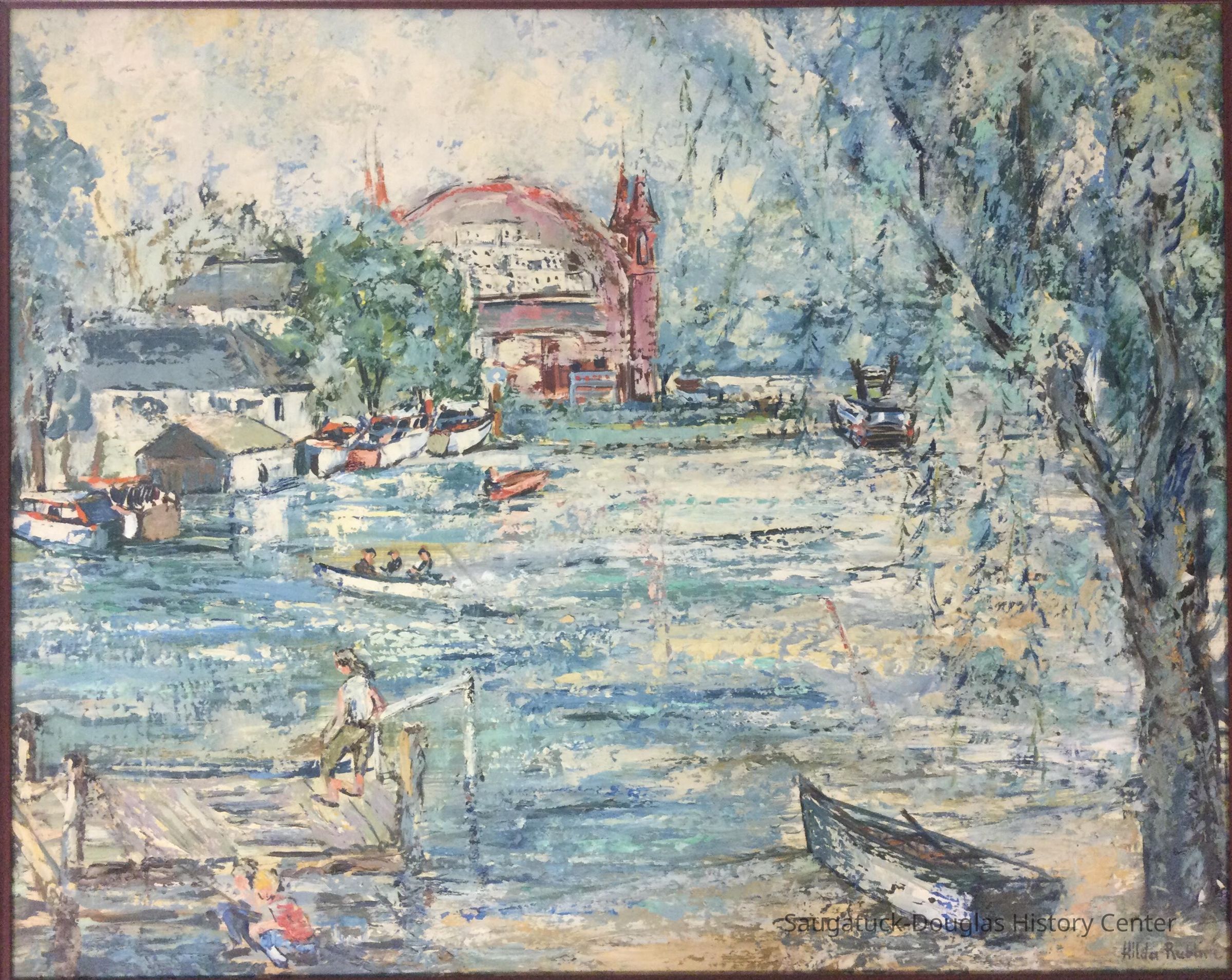
Kalamazoo River with Big Pavilion by Hilda Rubin
2018.12.01
Collecting the Art CoastGarden Art
Oil
Big Pavilion 1909-1960
Artworks1909 Big Pavilion -1960
Gollannek, Eric 1975-
2018.12
Mundinger, Fred
Donation
Rubin, Hilda
1940 - 1960
Technique: Oil Paint
Signed Name: Hilda Rubin Signature Location: Lower right corner
Kalamazoo RiverPaintingBig Pavilion
24 in
30 in
AC bay 07
Art Conservation Room
Good
Rubin, Hilda
Curator’s Choice Exhibit
Hilda Rubin Pierce 1921 - 2015 The Big Pavilion from the West Bank of the Kalamazoo River, Saugatuck c. 1950 | oil on masonite board Notes: As a teenager, Hilda Rubin studied art in Vienna with expressionist painter, Oskar Kokoschka, before fleeing the country as a Jewish refugee following the German invasion, or Anschluss, of Austria in 1938. Traveling alone, at age 16, Hilda first went to London and then, in 1939, found asylum with relatives in Chicago. There, she took art classes at Hull House and studied at the Art Institute of Chicago. Her Chicago mentors included artists, Rudolph Weisenborn, Rudolph Pen, and Harry Mintz. A profile of Rubin from the journal, American Artist, described Hilda traveling and painting at art colonies along Lake Michigan in the summers during the 1940s. Rubin continued to paint and teach art in Highland Park, Illinois. She exhibited paintings at the Art Institute of Chicago, Sherman Gallery, Mandel Brothers, and summer art fairs. Married to Norman Pierce, a Chicago radio announcer and film producer, Hilda moved to La Jolla, California in the mid 1970s. This colorful image shows the Big Pavilion on a typical summer day. The brush strokes are filled with bold expression. There is activity portrayed, but one gets a strange sense of being in a “private” place. Possibly a well-kept secret? Collection: Saugatuck Douglas History Center Gift of: Fred Mundinger Accession: 2018.12.01
Hilda Rubin Pierce 1922 - The Big Pavilion from the West Bank of the Kalamazoo River, Saugatuck c. 1950 | oil on canvas masonite board Notes: As a teenager, Hilda Rubin studied art in Vienna with expressionist painter, Oskar Kokoschka, before fleeing the country as a Jewish refugee following the German invasion, or Anschluss, of Austria in 1938. Traveling alone, at age 16, Hilda first went to London and then, in 1939, found asylum with relatives in Chicago. There, she took art classes at Hull House and studied at the Art Institute of Chicago. Her Chicago mentors included artists, Rudolph Weisenborn, Rudolph Pen, and Harry Mintz. A profile of Rubin from the journal, American Artist, described Hilda traveling and painting at art colonies along Lake Michigan in the summers during the 1940s. Rubin continued to paint and teach art in Highland Illinois. She exhibited paintings at the Art Institute of Chicago, Sherman Gallery, Mandel Brothers, and Summer art fairs. Married to Norman Pierce, a Chicago radio announder and film producer, Hilda moved to La Jolla, California in the mid 1970s. This colorful image shows the Big Pavilion on a typical Summer day. The brush strokes are filled with bold expression. There is activity portrayed, but one gets a strange sense of being in a "private" place. Possibly a well-kept secret? Collection: Saugatuck Douglas History Center Gift of: Fred Mundinger 2018.12.01
From "Collecting the Lakeshore" 2025-2026 at the History Center main floor gallery Hilda Rubin Pierce 1921-2015 Big Pavilion from the West Bank of the Kalamazoo River, Saugatuck circa 1945-1950s | oil on panel This colorful image shows the Big Pavilion on a typical summer day. The brush strokes are filled with bold expression. Its style appears to have a different set of influences from the Post-Impressionism that dominated in Saugatuck before the Second World War. As a teenager, Hilda Rubin studied art in Vienna with expressionist painter, Oskar Kokoschka, before fleeing the country as a Jewish refugee following the German invasion, or Anschluss, of Austria in 1938. Traveling alone, at age 16, Hilda first went to London and then, in 1939, found asylum with relatives in Chicago. There, she took art classes at Hull House and studied at the Art Institute of Chicago. Her Chicago mentors included artists Rudolph Weisenborn, Rudolph Pen, and Harry Mintz. A profile of Rubin from the journal American Artist described Hilda traveling and painting at art colonies along Lake Michigan in the summers during the 1940s. Rubin continued to paint and teach art in Highland Park, Illinois. She exhibited paintings at the Art Institute of Chicago, Sherman Gallery, Mandel Brothers, and summer art fairs. Married to Norman Pierce, a Chicago radio announcer and film producer, Hilda moved to La Jolla, California in the mid 1970s. Gift of Fred Mundinger Accession 2018.12.01
Status: OK Status By: Eric Gollannek Status Date: 2018-05-14
05/14/2018
09/15/2026